"Fast, cheap, and done properly." Three words that turn up in almost every project request, and that describe something impossible. The iron triangle explains why. Here is what it says exactly, what it does not say, and the conversation worth having instead.
The three constraints
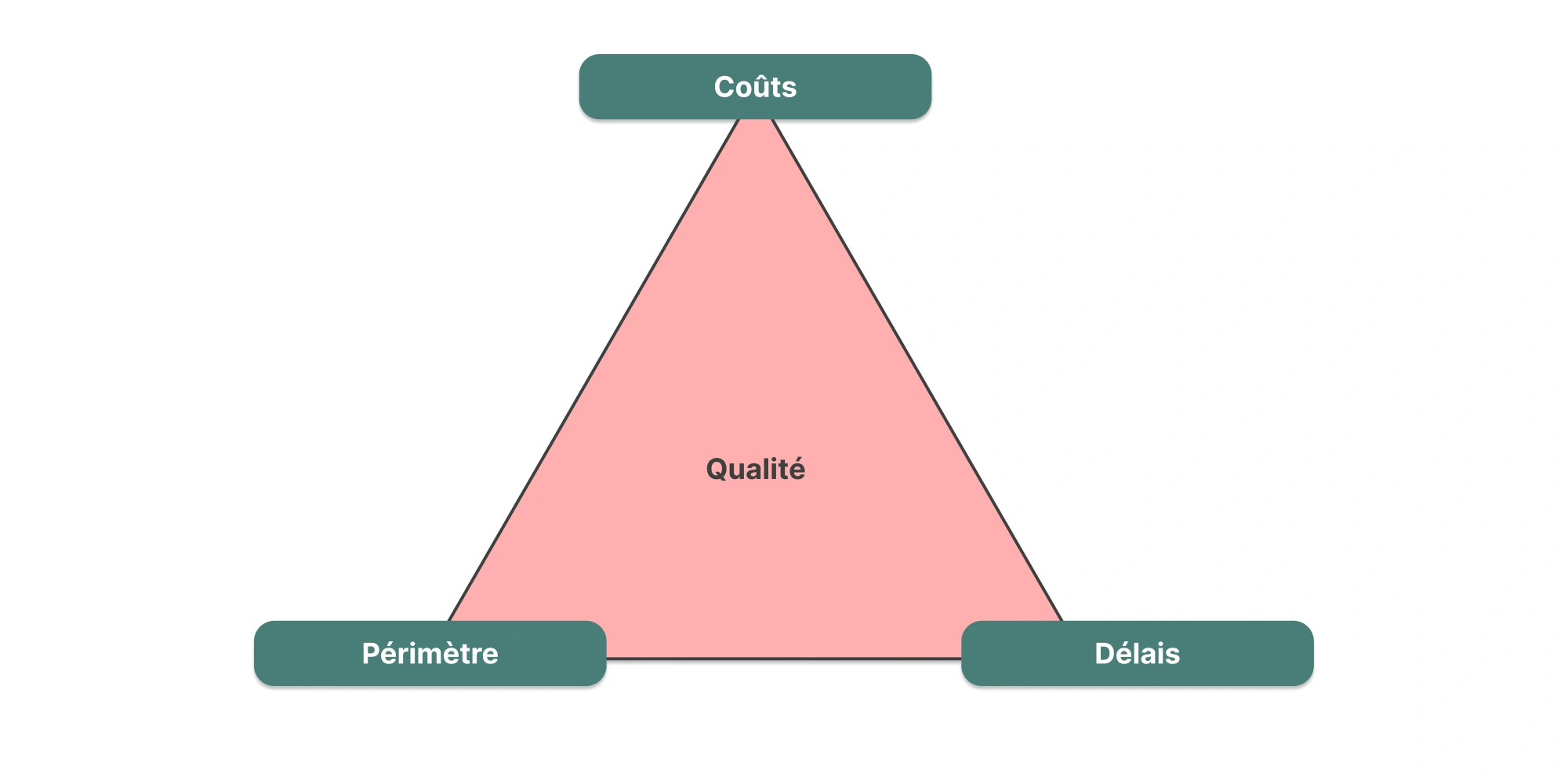
The iron triangle — also called the triple constraint, or simply the project management triangle — holds that every project plays out across three linked variables.
- Time: when the project has to be delivered. The key dates, the milestones, the final deadline.
- Cost: what the project is allowed to spend. People, but also purchases, subcontracting and equipment.
- Scope: what the project has to produce. The deliverables, the requirements, the boundary of what is included.
The principle fits in one sentence: touch one and you necessarily affect the other two. You do not shorten a deadline without raising the cost or cutting the scope. You do not cut a budget without extending the deadline or delivering less.
This is not a management rule, it is an arithmetic constraint. It holds whatever the team is worth.
Fix two, and the third absorbs
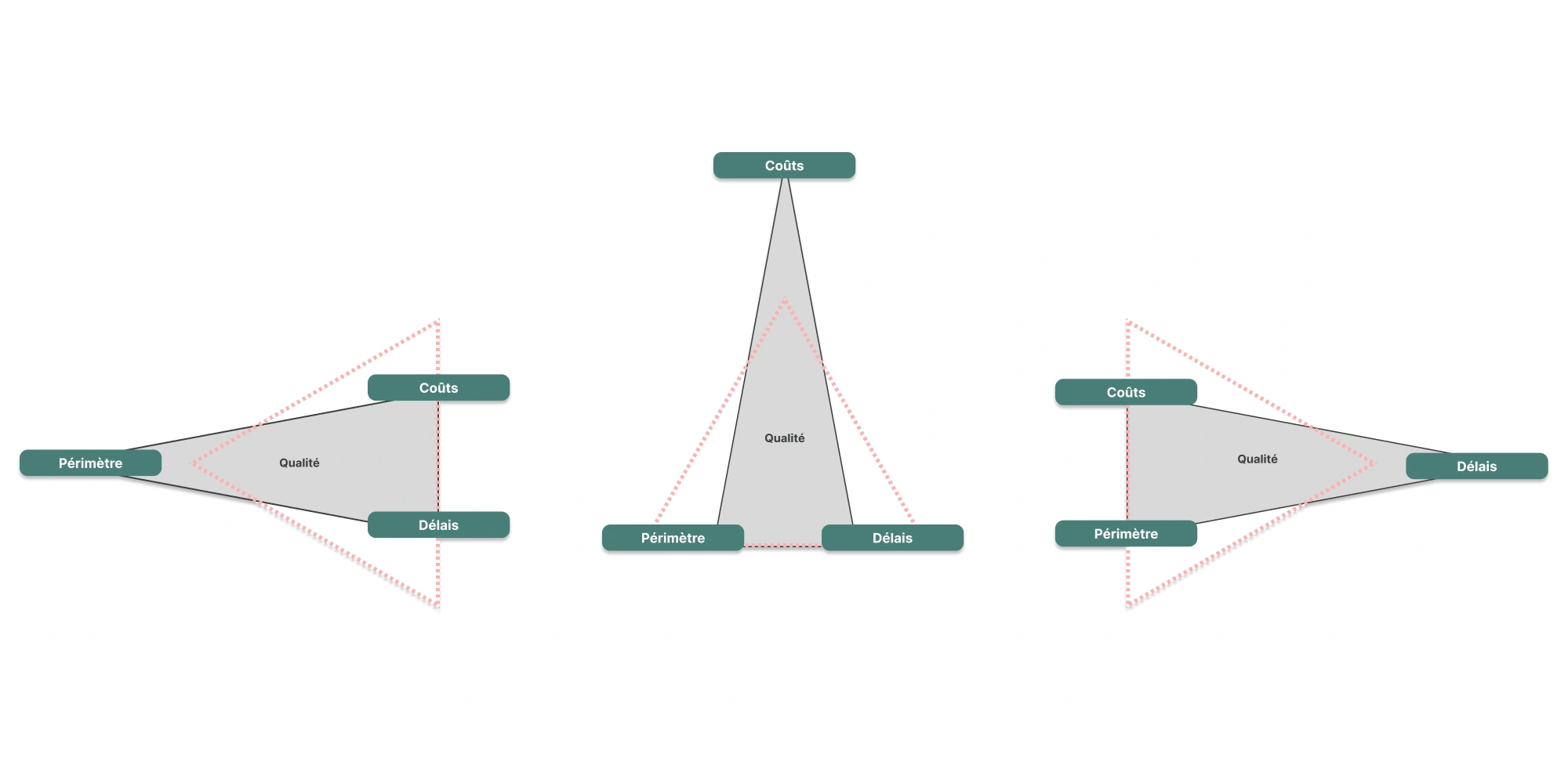
The classic reading of the triangle is to pin two corners and let the third one take the strain. Three combinations exist.
- Time and cost fixed: the scope shrinks. You will not deliver everything, and what comes out has to be decided now.
- Time and scope fixed: the cost rises. More people, outside reinforcements, overtime.
- Cost and scope fixed: the date moves out. Often the most honest combination, and the hardest to get accepted.
All three work, on one condition: that the trade-off is made at the start and written down. A trade-off discovered in month six is no longer a trade-off, it is a failure.
Where the model stops
The triangle is useful for explaining an impossibility. It is much less useful for running a project, and three reservations are worth knowing.
Quality is not the area of the triangle
You often read that the area of the triangle stands for quality, and that it shrinks as the corners are pulled in. That is an image, not a measurement. A project with a reduced scope can be excellent at what it does deliver, and a complete project delivered on time can be mediocre throughout.
Quality depends on how the work is done, not on the geometry of a diagram.
It ignores people
The model reasons in variables, not in availability. Two parallel tasks handed to the same person do not run in parallel, and no corner of the triangle says so. The resource constraint is real, and invisible here.
It describes, it does not decide
This is the limitation that hurts most in practice. The triangle says the three constraints are linked. It does not say which one you should protect. That is exactly the question every project asks, and leaving it unanswered produces the scenario below.
The classic mistake: trying to fix all three
A scope written into a contract, a date announced to the client, a budget signed off. All three corners are locked before the project even starts, and nobody framed it as a choice.
In engineering, a structure whose degrees of freedom have all been removed is called statically indeterminate. It no longer deforms, so it absorbs stress internally until something gives. An over-constrained project behaves the same way: the pressure does not disappear, it moves onto the team.
The symptoms are always the same. Trade-offs surface in crisis meetings rather than in a steering committee. Everyone defends their own scope. The first surprise, which should have cost three days, turns into a general negotiation.
AI has revived this dream with some force. The productivity gains are real on certain tasks, but they move the cursor — they do not remove the trade-off.
The constraint matrix: one role per variable
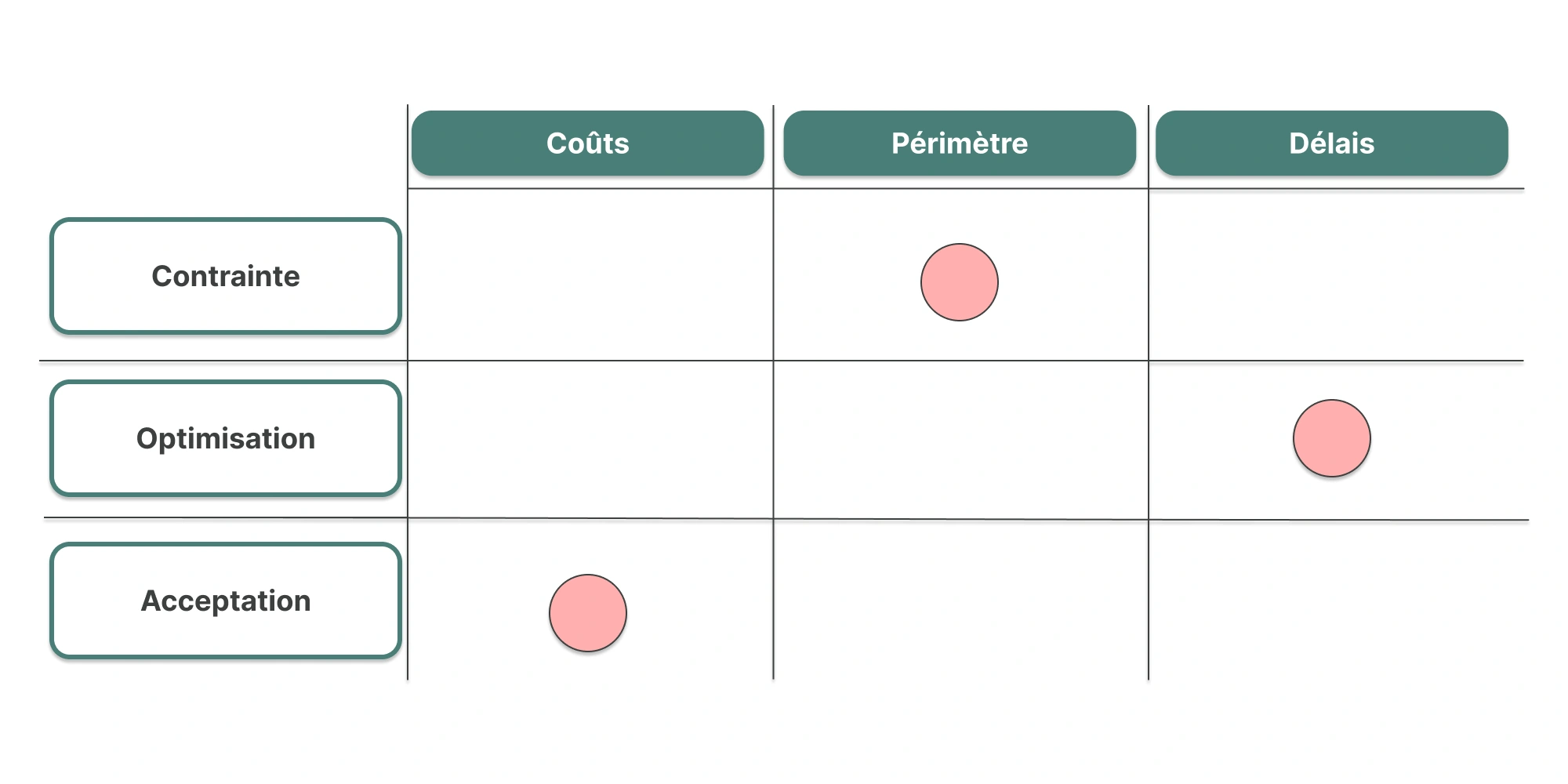
The way out is not to pin two corners and sacrifice the third. It is to give each one a different role.
- Constrained: the non-negotiable variable. There is only one, and everything else is organised around it.
- Optimised: the variable under permanent watch, where every possible gain is pursued without ever threatening the first one.
- Accepted: the adjustable variable, the one that will move. Uncomfortable to say out loud, essential to write down.
This matrix is filled in with the sponsor, not after them. Three questions are enough: what is non-negotiable, what are we trying to optimise, and where do we accept some give.
The conversation takes twenty minutes and protects the project for six months. It is also the project manager's best defence when something unexpected lands: the trade-off has already been settled.
What your constraint says about how you work
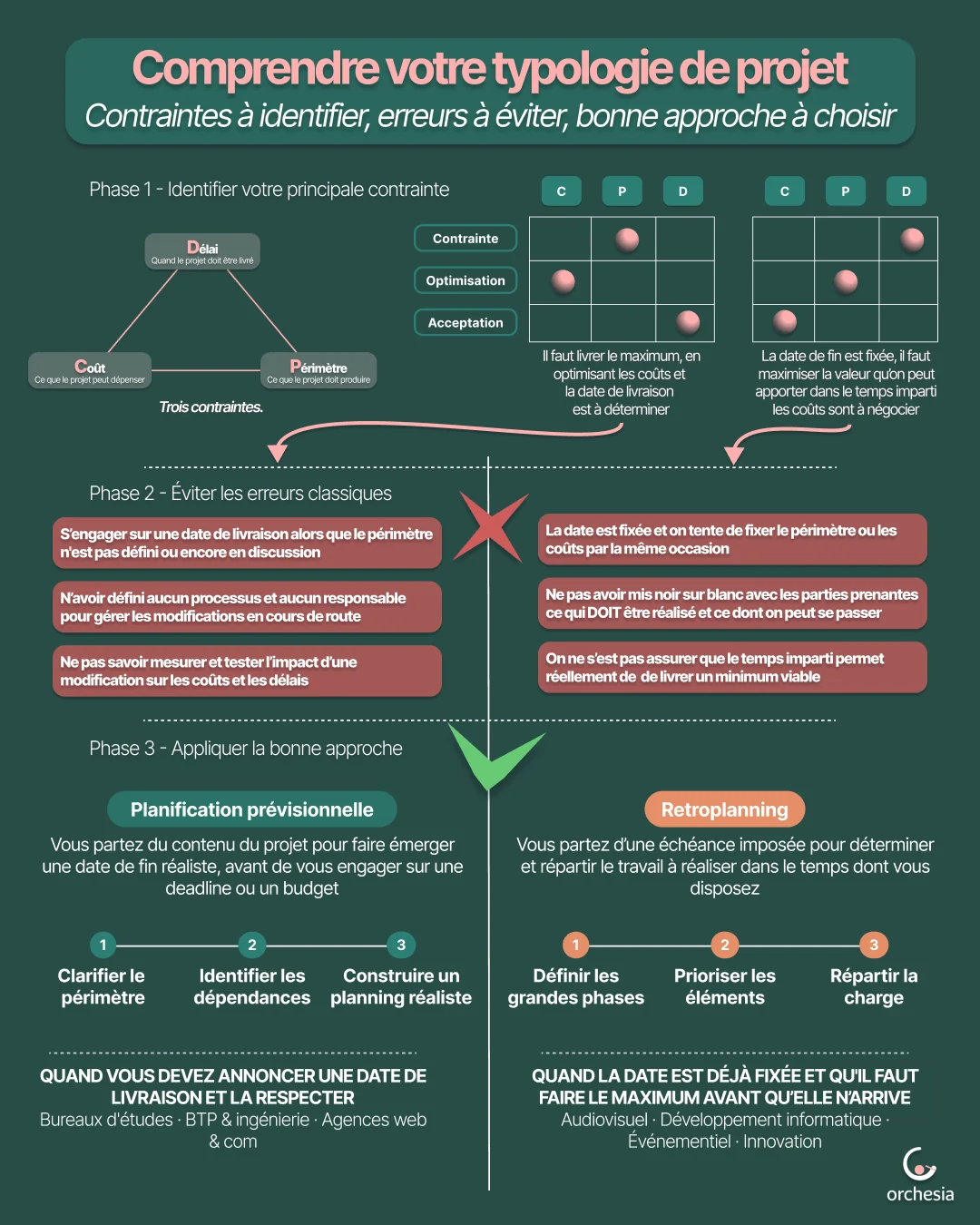
The corner you declared non-negotiable decides how you organise the work. Two cases dominate in the field.
Scope is the constraint
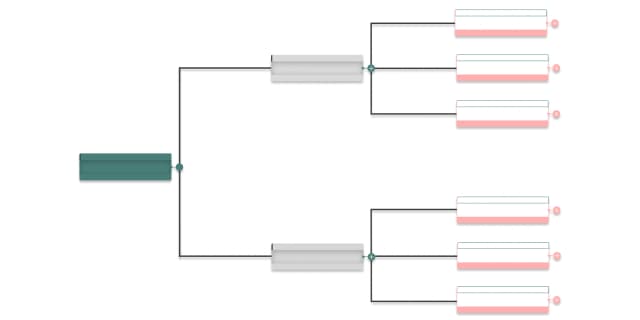
What has to be delivered is defined, contractual, sometimes subject to standards. You start from the content to arrive at a realistic finish date, and you do not commit to a deadline before you have calculated it.
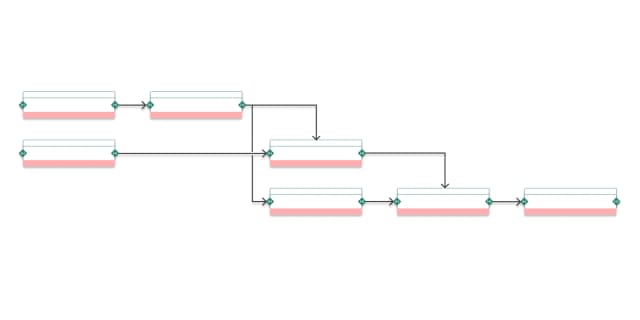
That is the logic of project planning: break down the scope, declare the dependencies, derive the schedule. Engineering firms, construction and web agencies almost always work this way. The matching tooling is project planning software.
The date is the constraint
A trade show, a board meeting, a regulatory obligation. The deadline is set and will not move. So you start from the end and organise what can realistically be done in the time available, by prioritising.
That is the logic of backward planning: anchor the phases, prioritise for the day itself, spread the load. Audiovisual production, software, events and innovation recognise themselves here. The matching tooling is backward planning software.
These are two ways of organising and steering, not two preferences. Most traditional tools are good at one or the other, rarely both, which explains part of the disappointment at the point of choosing.
The choice of project management methodology follows the same logic: a scope constraint calls for a sequential approach, a date constraint calls for an iterative one.
What to settle before you start
The iron triangle solves nothing on its own. It makes visible a trade-off that many organisations would rather not put on the table, and that is already a great deal.
Three moves are enough at the start: name the non-negotiable constraint, write down what you accept will move, and have the person who commissioned the project validate it. The rest — scoping and estimating — follows from that choice.
In Orchesia, both modes sit side by side. The structured mode starts from the content, breaks it down, declares the dependencies and calculates the date. The simplified mode starts from an imposed date and works back up the chain. You choose according to your constraint, not according to the tool.