
PERT Chart Software: Visualize Dependencies and Build Reliable Timelines
Orchesia guides you through building your PERT diagram, modeling task sequences, identifying the critical path, and establishing reliable timelines before you commit.
Why use planning software to build a PERT chart?
Because a poorly built PERT doesn't make timelines reliable. It creates a false sense of rigor.
Because without software, your dependencies are never formalized
Without a PERT diagram, constraints stay in people's heads. Blockers surface during execution, never upstream.
Because a PERT without an upfront WBS rests on a fragile structure
Without upfront structuring (WBS), dependencies are defined between heterogeneous elements. The diagram mixes levels and the calculations no longer mean anything.
Because the critical path shouldn't be calculated without field teams
Without collaborative planning software, the PERT is built by management alone and ignores real operational constraints. It looks rigorous, but it's bypassed as soon as work starts.
Why PERT charts almost vanished from software
Of 50 tools tested in late 2025, two display a PERT chart. One uses it to build the schedule.
MS Project shows a network, but the wrong way round
The task network is only reachable once the Gantt chart is entered. It reviews a schedule already set rather than building one. And the rendering has not moved since the 2000s.
Modern tools dropped the network view
You declare predecessors, sometimes blockers, but no view shows the full sequencing. Where a critical path exists, it comes out of a calculation you cannot inspect.
Excel computes neither float nor critical path
Early and late dates are worked out by hand, and reworked by hand at every change. In practice nobody does it twice.
The only one doing the full chain, and nobody opens it
It does chain WBS, PERT and Gantt properly. But the interface is twenty years old, the licence is expensive and it targets large enterprises. The method exists; it is locked away.
PERT was not dropped because it was useless. It was dropped because displaying it took an effort vendors did not make.
Building the dependency network
Sequencing is declared once. Dates, float and the critical path follow, and are recomputed at every change.
PERT within a structured upfront planning approach
In Orchesia, PERT software builds on a clear project structure. It analyzes real dependencies between tasks and automatically calculates the critical path.
Define dependencies from a solid structure
Orchesia guides you in building the PERT from your Work Breakdown Structure. Dependencies are defined between coherent elements at the right level of granularity. The critical path reflects project reality.
Identify what truly drives your timelines
The PERT diagram highlights constrained sequences and the critical path. You know exactly where your deadlines are determined, before making any commitment.
AI working on your project
Describe your project in one sentence: AI generates the WBS, predicts the tasks and proposes the dependencies. You review and adjust in one click. You keep control — AI just speeds it up.
Make trade-offs based on facts, not gut feel
In Orchesia, PERT becomes a decision-support tool. You simulate the impact of a priority change or new constraint on timelines before it becomes a problem.
A well-built PERT diagram means an identified critical path, anticipated risks, and timelines you can defend.
Dependencies rank above poor execution
Among the failure causes recorded by PMI, mis-identified sequencing weighs more than procrastination or lack of resources.
- 26%
of failed projects cite poorly identified resource dependencies
PMI, Pulse of the Profession 2018, 4,455 practitioners - 12%
cite poorly identified task dependencies
PMI, Pulse of the Profession 2018 - 3rd of 15
organising tasks, among the main challenges reported by French SMEs
Capterra 2018, 753 respondents
An undeclared dependency only shows up when it blocks. By then it cannot be solved, only absorbed.
Dependencies: before and after
Without a dependency network
The sequencing exists, but nowhere you can see it.
- Blockers surface at the moment they block
- No way to tell which task moves the end date
- The critical path is guessed, not computed
- A delay spreads without anyone knowing how far
- Every change means checking everything by hand
With a dependency network
Sequencing is declared, therefore computable.
- Blocking tasks are visible before kickoff
- The critical path is traced and kept current
- Available float is quantified per task
- A slip propagates its effects automatically
- Cycles and inconsistent links are rejected
Who uses the PERT chart
The dependency network serves those who commit to a date and must explain where it comes from.

Engineering firms
To identify coordination points between disciplines before pricing a study.

Construction and site management
To formalise the order of trades before the site opens.

Project teams in SMEs
To know which task actually moves delivery, instead of reacting to blockers one by one.

Students and lecturers
To build a complete PERT chart — early and late dates, float, critical path — without computing it by hand.
A reliable PERT doesn't build itself.
It rests on a clear project structure.
See Orchesia in actionFrequently asked questions
PERT models dependencies between tasks and identifies the critical path. Gantt charts schedule tasks over time with dates. You build the PERT first to understand constraints, then the Gantt to plan. Orchesia guides you in that order.
Yes. PERT analyzes dependencies between project elements. If those elements aren't clearly defined in a WBS, dependencies are inconsistent and the critical path is meaningless.
Yes. Dependencies are co-built with business teams in the same workspace. They're the ones who know the real operational constraints.
A few minutes if the WBS is already built. AI can also generate an initial dependency structure from a one-sentence project description.
Technically yes, but Excel doesn't automatically calculate the critical path, doesn't dynamically visualize dependencies, and doesn't update when the project evolves. The smallest change forces a manual rebuild.
You enter a single duration per task. If you use the three-point method — (Optimistic + 4 × Most likely + Pessimistic) / 6 — compute the expected duration and enter that value. The forward and backward passes, total float and free float are then calculated by Orchesia.
Total float is how long a task can slip without moving the project end date. Free float is how long it can slip without moving its own successors. A task on the critical path has zero total float, which is exactly what makes it critical.
They are close and often used together. CPM computes the longest path through the network to find the project duration. PERT adds probabilistic estimation of durations. Orchesia computes the network, the passes and the critical path; the estimation method stays yours.
Simple pricing, no surprises
All the tools to structure and run your projects. 30-day free trial.
per user, billed monthly
View pricing30-day free trial · No commitment · Cancel anytime
What's included
- Access to all features
- Free updates
- Document storage
- Real-time collaboration
- PDF export
 AI credits
Further reading
The methods behind the tool, explained in detail.
 How to estimate the duration of a task in a projectWho estimates, under what conditions, and why the buffer must not hide inside the figure. The six rules that make an estimate usable.
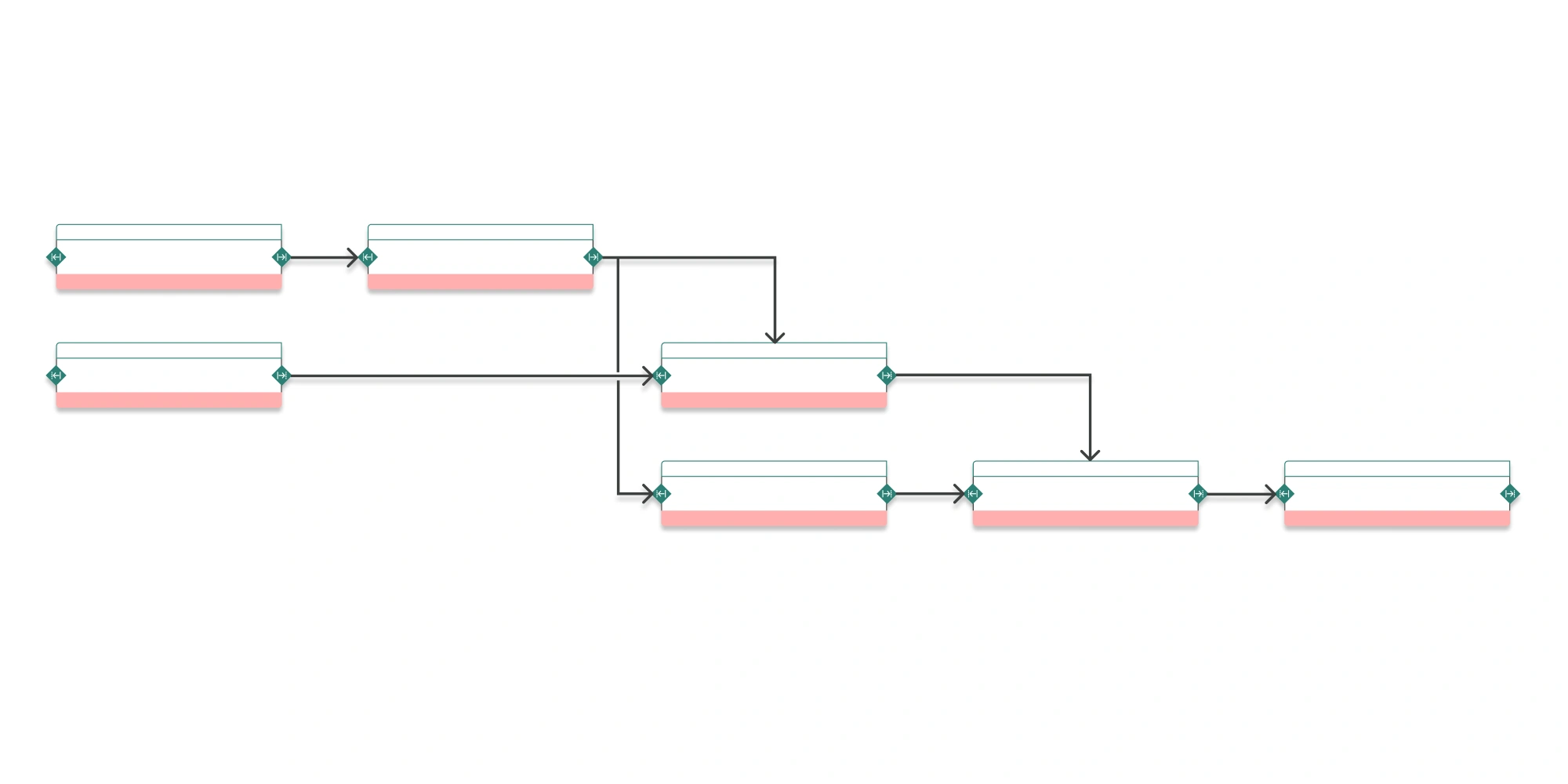 What is a PERT chart? Definition and role in project managementA PERT chart models the dependencies between tasks and reveals the sequence that actually drives the end date. Definition, notation and how it differs from a Gantt chart.
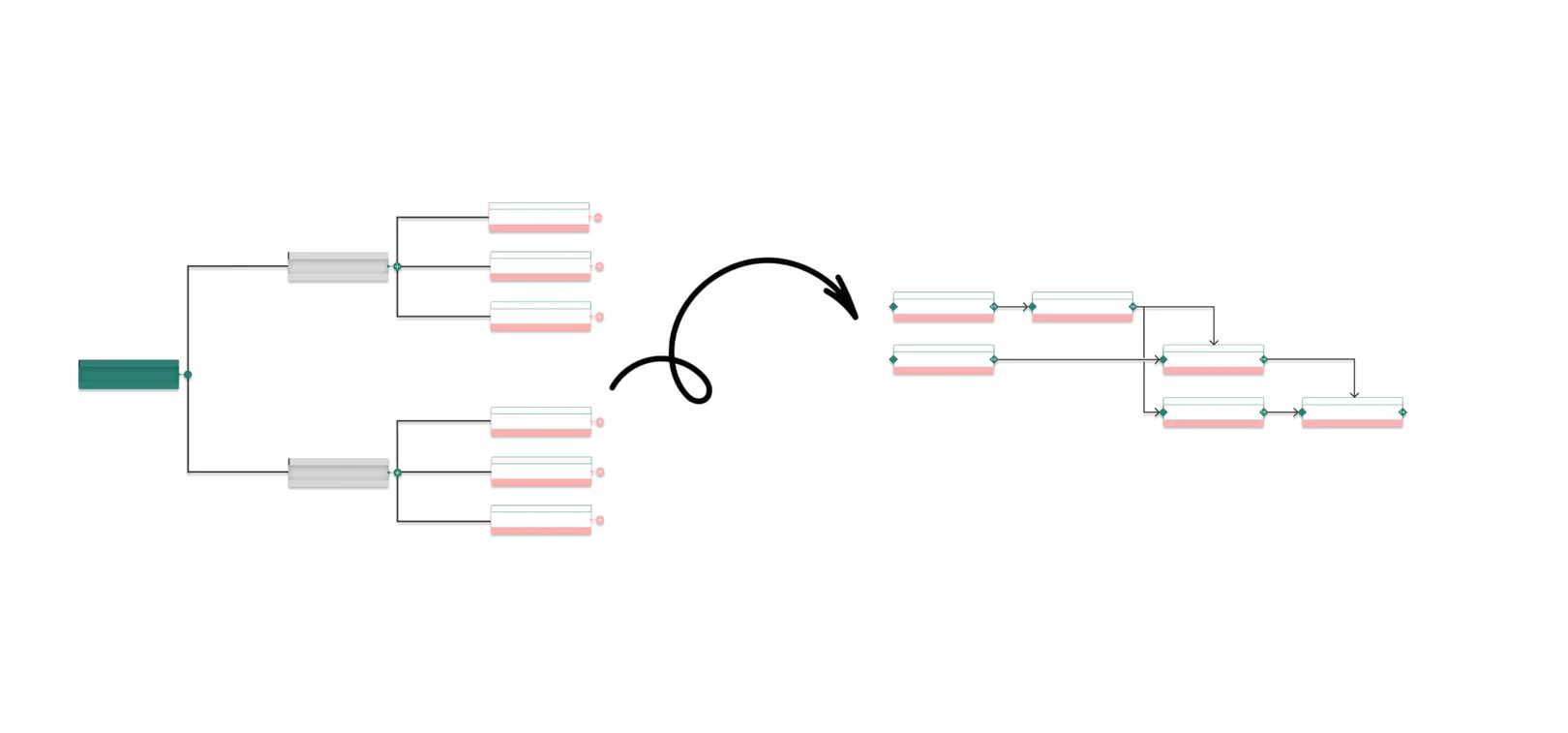 How to build a PERT chart, step by stepFrom a list of work packages to a dependency network you can compute: the method, the notation and the errors that make a network useless.
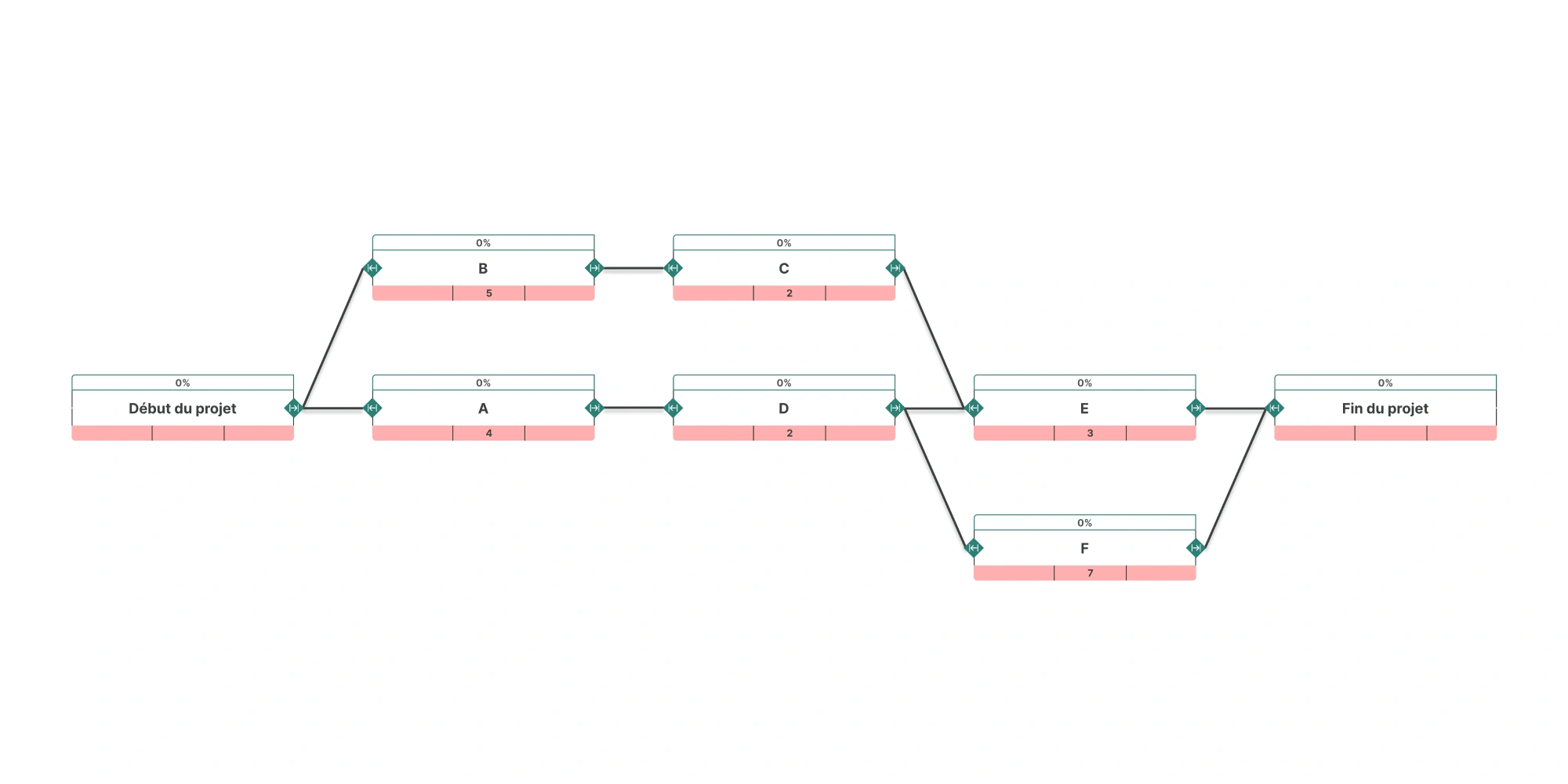 PERT formula: expected duration, float and the critical pathThe three-point estimate, the forward and backward passes, total and free float: the arithmetic behind a schedule you can defend.
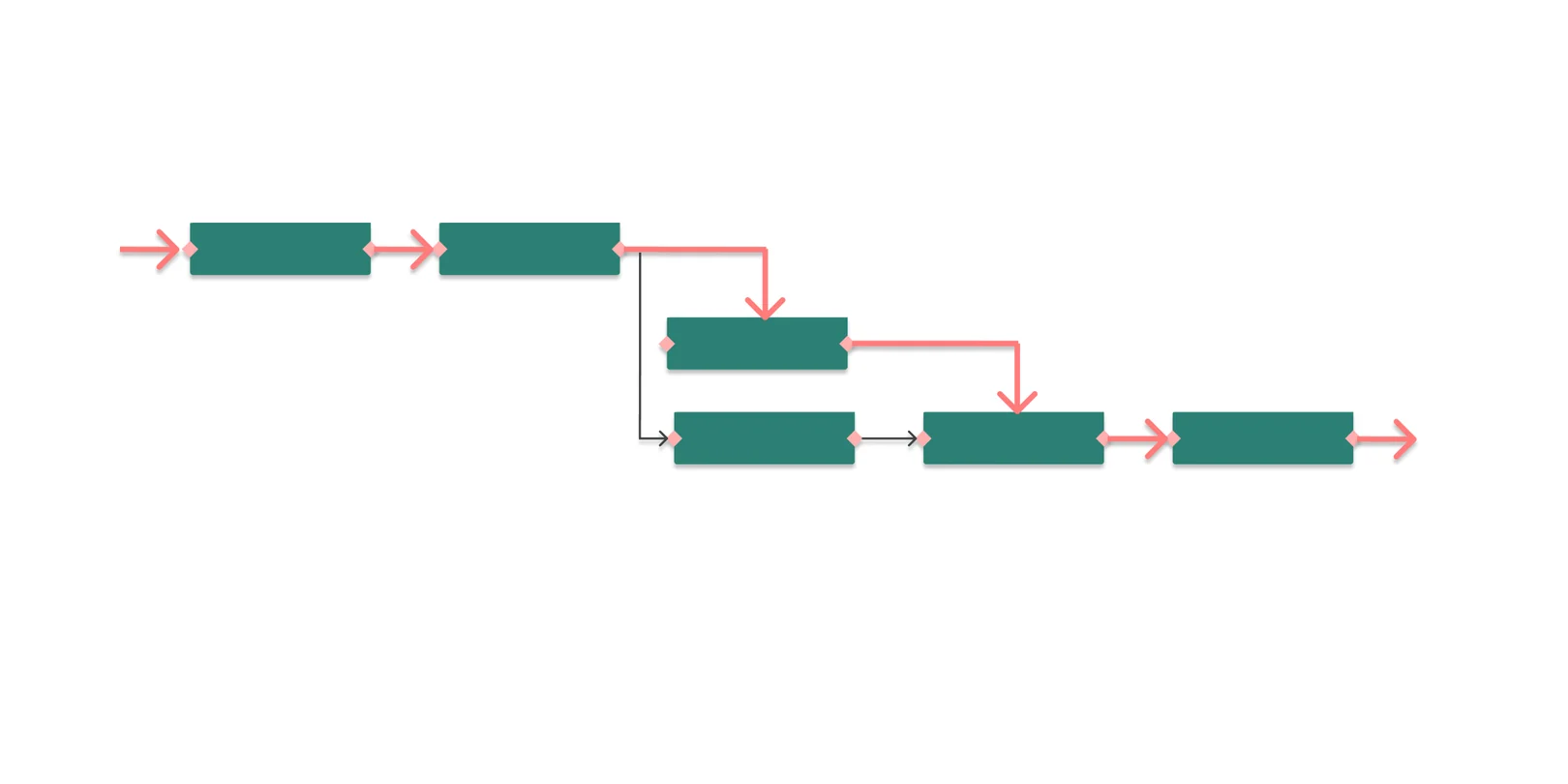 What is the critical path in project management?The critical path is the longest chain of dependent tasks in a project. It sets the minimum duration — and any delay on it moves the end date.
Your timelines deserve better than a rough estimate.
Build your PERT in minutes, identify the critical path, and commit on solid ground. 30-day free trial, no credit card required.