
Campaign management software: scope the deliverables before launch
A poorly scoped campaign is expensive, because deliverables are never truly clear. Orchesia structures campaign upfront work: explicit deliverables, aligned approvals and reliable timelines before the first brief.
Three situations that derail campaigns before they even launch

A brief signed too quickly, with no defined deliverables
The brief is approved without formats, scope, and responsibilities being properly established. Misunderstandings surface during production with unplanned back-and-forths and a client relationship that starts to strain.

Teams and client not working from the same baseline
Everyone interprets the brief differently. Trade-offs arrive too late, priorities shift mid-project, and the campaign loses coherence with each iteration.

Deadlines announced before scope is stabilized
Deadlines are communicated to the client before deliverables and dependencies are clarified. Adjustments pile up, dates slip, and trust erodes deliverable by deliverable.
What Orchesia gives you
Solutions built for the way your teams actually work

Clear deliverables before the first file is produced
Formalize expected deliverables precisely: formats, content, scope, and responsibilities. Everyone knows what's included and what isn't — before production starts.

A shared framework between teams and client from the scoping phase
Set objectives, priorities, and approval rules in a common view. Internal teams and the client work from the same baseline. No more misunderstandings discovered mid-production.

Timelines and budget committed on real foundations
Link deliverables and dependencies to measure the real impact of scope on the schedule. Commitments are justified and owned from the start — not corrected under pressure mid-campaign.
AI-assisted
AI does the legwork: project structure (WBS), task predictions, dependencies and critical path suggested automatically. You stay in control — AI just gets you there faster.
A well-scoped campaign means clear deliverables, an aligned client, and timelines you can actually meet.
Orchesia structures campaign upfront work so teams commit on solid ground and execute without constant catch-up.
Campaign deliverables structured in a single shared view
Formalize expected deliverables from the start: formats, content, scope, and approval levels. Everyone knows exactly what needs to be produced, what's in scope and what isn't — before launch.
A shared framework that aligns teams and client in real time
Orchesia establishes a shared campaign vision: objectives, priorities, roles, and approval rules. Internal teams and the client work from the same structure. What's decided is visible. What still needs to be resolved is too.
AI working on your project
Describe your project in one sentence: AI generates the WBS, predicts the tasks and proposes the dependencies. You review and adjust in one click. You keep control — AI just speeds it up.
A schedule generated from the campaign structure, not entered manually
With deliverables and dependencies clarified, the schedule is generated from the real campaign structure. Timelines and budget are committed from explicit assumptions — not optimistic estimates corrected mid-production.
The client inside the project, read-only
Add the client as a Visitor: they see the deliverables waiting on their approval and the effect of their response time on everything downstream. Chasing stops being an email exercise.
The gap between the campaign sold and the campaign shipped
The starting schedule is recorded when the quote is signed. When a review takes seven days instead of two, the variance is dated and visible — which turns an end-of-campaign argument into a shared fact.
Profitability per client, readable at a glance
Build charts on your portfolio columns — client, budget, campaign type — and filter by period. The monthly review stops starting with an hour of spreadsheet formatting.
Without upfront project scoping
The campaign starts on uncertain ground.
- Brief signed quickly, deliverables undefined
- Implicit or shifting client expectations
- Teams with no shared framework on priorities and approvals
- Deadlines announced before scope is stabilized
- Back-and-forths piling up and client relationship fraying
With Orchesia
The campaign starts on solid ground.
- Deliverables defined, formalized, and understood by all parties
- Client aligned on scope and expectations before launch
- Teams sharing a common vision of objectives and priorities
- Timelines committed from clear, realistic assumptions
- Smooth collaboration, decisions made with confidence
One agency in a hundred bills all its out-of-scope work
Survey run in April 2025 among 273 owners and senior leaders of US marketing, creative, design and advertising agencies.
- 1%
of agencies bill all the out-of-scope work they actually deliver
Ignition, Agency Pricing and Cash Flow Report 2025, 273 agency leaders - 78%
rarely or only sometimes charge for out-of-scope work
Ignition, Agency Pricing and Cash Flow Report 2025 - 57%
lose between $1,000 and $5,000 a month in unbilled work, 30% lose more
Ignition, Agency Pricing and Cash Flow Report 2025
Out-of-scope work is not refused: it is delivered, then given away. What is missing is not firmness, it is a record of what was agreed.
Simple pricing, no surprises
All the tools to structure and run your projects. 30-day free trial.
per user, billed monthly
View pricing30-day free trial · No commitment · Cancel anytime
What's included
- Access to all features
- Free updates
- Document storage
- Real-time collaboration
- PDF export
 AI credits
Frequently asked questions
No. Orchesia works before production — to structure campaign upfront work: deliverables, decisions, dependencies, scheduling, and commitments. Creation and distribution then happen in your usual tools.
Yes. Orchesia is used by agencies working with external clients and by in-house communications teams managing cross-functional campaigns. In both cases, it aligns stakeholders and secures commitments.
No. Orchesia is primarily an internal team tool. Selected elements can be shared with the client to clarify deliverables and commitments, but the client doesn't need access to the tool.
Scoping takes a little time upfront but saves a lot downstream. Orchesia avoids unnecessary back-and-forths, last-minute adjustments, and deadline renegotiations mid-production. The time invested upfront is recovered well before the campaign ends.
A few hours is enough. The tool is built around concepts familiar to communications teams: deliverables, decisions, dependencies, scheduling. The AI speeds onboarding further by generating an initial structure from your campaign description.
Further reading
The methods behind the tool, explained in detail.
 Scope creep: why projects grow without anyone decidingScope creep is rarely a single bad decision. It is the accumulation of small additions nobody logged, on a scope that was never fully written down.
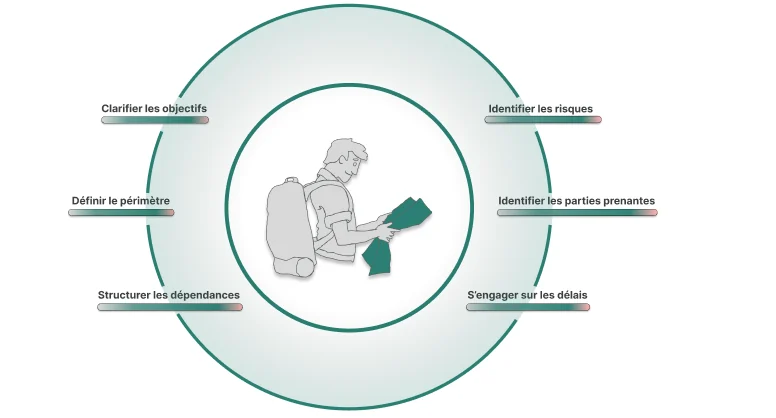 How to scope a project before you commit to a dateFraming is not paperwork. It is the last moment where a decision is cheap. Here is what a scoping stage has to produce before anyone opens a schedule.
Stop launching campaigns from vague briefs.
Orchesia helps communications teams clarify deliverables, align the client, and build reliable timelines before production starts.
30-day free trial • No commitment • No credit card