Agile backward planning is a way of organising a project when the end date is already fixed. You no longer calculate a deadline from the content: you start from the deadline, work back through time, and decide what is genuinely achievable by the day itself. The point is not to promise everything. It is to know what has to be delivered, what can wait, and what should disappear before it consumes any time.
When the problem is neither skill nor goodwill
Two situations come up again and again.
On the client side: nobody understands why the supplier never delivers everything that was agreed. On the supplier side: nobody knows how to produce something clean on a limited budget or against an imposed date.
In most cases this is neither a lack of skill nor a lack of goodwill. It is the wrong approach: the date or the budget was fixed before the scope was clear, and then everyone kept promising as though everything were still possible.
Backward planning answers that situation by changing the question. You stop asking "how do we do all of it by the deadline?" and start asking "what is achievable, useful and sustainable by the deadline?"
What is agile backward planning?
In project management, agile backward planning describes an approach that starts from a date that is already imposed — a launch, a delivery, an event, a product release — and organises the work backwards in order to hold it.
It answers one central question: given the deadline and the means available, what absolutely has to be produced, in what order, and what can be set aside?
The logic is close to the agile mindset: deliver what genuinely matters, protect teams from overload, and open an honest conversation with the client about what is possible and what is not. Beyond frameworks and rituals, it is first of all a state of mind — accepting that time is non-negotiable, and that the scope is the thing that can move.
Backward planning and project planning: two different logics
Classic planning calculates a date from the content, the approach described among others in the PMI standards. Backward planning starts from the date and adjusts the content: same vocabulary, opposite constraint.
Project planning calculates a date from the content: you clarify what has to be produced, in what order, how long it takes, and then commit to a date you can defend.
Agile backward planning starts from a date that is already fixed and organises the path to respect it. The content then becomes the adjustable variable.
The two are complementary, but they answer different situations:
- project planning: the date has to be estimated;
- agile backward planning: the date is imposed, and the work has to be organised to meet it.
Many organisations build their projects around forward planning. That is not a flaw. But as soon as the deadline is non-negotiable and the scope can move, agile backward planning fits better.
It is not a method of resignation
Cutting the scope without saying so, compressing the work, or promising to "see how it goes" is not backward planning. It is leaving things implicit.
A useful backward plan forces three explicit decisions:
- anchor the real calendar constraints;
- prioritise what creates value;
- confront the load with the capacity of the team.
It is a method of clarity, adaptation and flexibility. It lets you deliver what genuinely matters, rather than announce everything and disappoint.
What backward planning covers
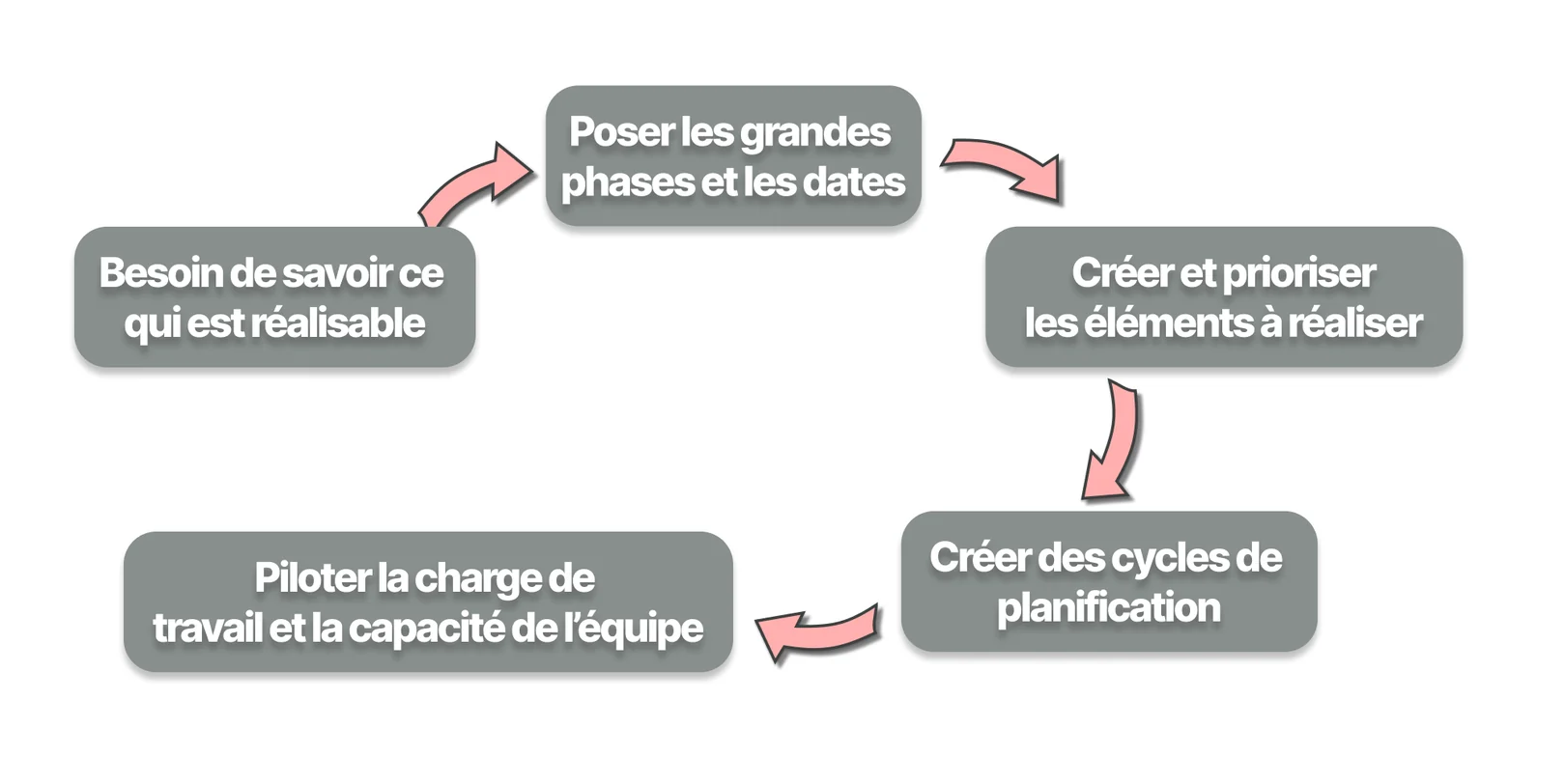
Backward planning means deciding what fits into the time available. It runs through three movements.
1. Define the main phases
You fix the end date. You position the non-negotiable milestones — regulatory dates, trade shows, approvals, events. Then you sequence the period into concrete phases: design, production, testing, delivery, for example.
The natural tool at this stage is a roadmap: a simple view of the phases on the real calendar.
What you gain: everyone can see where the project is going; the milestones are anchored in the calendar; vague phases become a concrete sequence.
2. Prioritise the items
You list what you would do if time were infinite. Then you decide: what genuinely creates value? What can wait? What can disappear?
A prioritisation board makes those decisions visible. That is the role of the MoSCoW matrix, which sorts the scope into four levels and keeps the must-have items to around 60% of the load.
What you gain: what matters ships first; the superfluous is identified before it consumes time; the team knows what to do when time runs short.
3. Spread the load
You create work cycles with start and end dates. You estimate the real capacity of the team. You choose the items for each cycle by weighing the load against that capacity.
Without this step, a backward plan stays a visual intention. With it, you can see whether the deadline still holds, or whether the scope needs trimming again.
What you gain: the load is visible before launch; overload peaks at the end of the period are avoided; gaps between capacity and load are anticipated.
Which projects does backward planning suit?
Backward planning suits projects where the time constraint is non-negotiable and the scope can move: audiovisual production, video game studios, software development, events, innovation, campaigns, product releases.
It is not the right approach for every project. When the date has to be calculated from stable content, with strong dependencies and a commitment to defend, project planning remains the right frame.
The simple test: if the date is already fixed and "all of it" is not sustainable, backward planning becomes relevant.
What backward planning is not
A few confusions are worth clearing up. Backward planning:
- is not a frozen spreadsheet nobody ever updates;
- is not a promise to deliver everything by "compressing" it;
- is not a way to hide a reduction in scope;
- is not reserved for Scrum or any particular agile framework;
- is not the opposite of planning: it is a different answer to a different constraint.
A credible backward plan rests on anchored phases, explicit priorities, and a load weighed against real capacity. If one of those is missing, the date on display is an illusion.
Summary
Agile backward planning starts from a date that is already fixed and organises the project to deliver the most value in the time available.
It runs through three movements: anchor the phases and milestones, decide what creates value, and weigh the load against the capacity of the team.
It is not a method of resignation. It is a clear-eyed way of approaching projects where time is non-negotiable and the scope, for its part, can still move. A backward planning tool does not make those decisions for you — it keeps the phases, the priorities and the execution in the same place, so the date on display stays connected to the work.