The SCRUM method: everything you need to know about the fundamentals of effective Agile project management
Estimated reading time : 5 minThe 3 essential Scrum roles
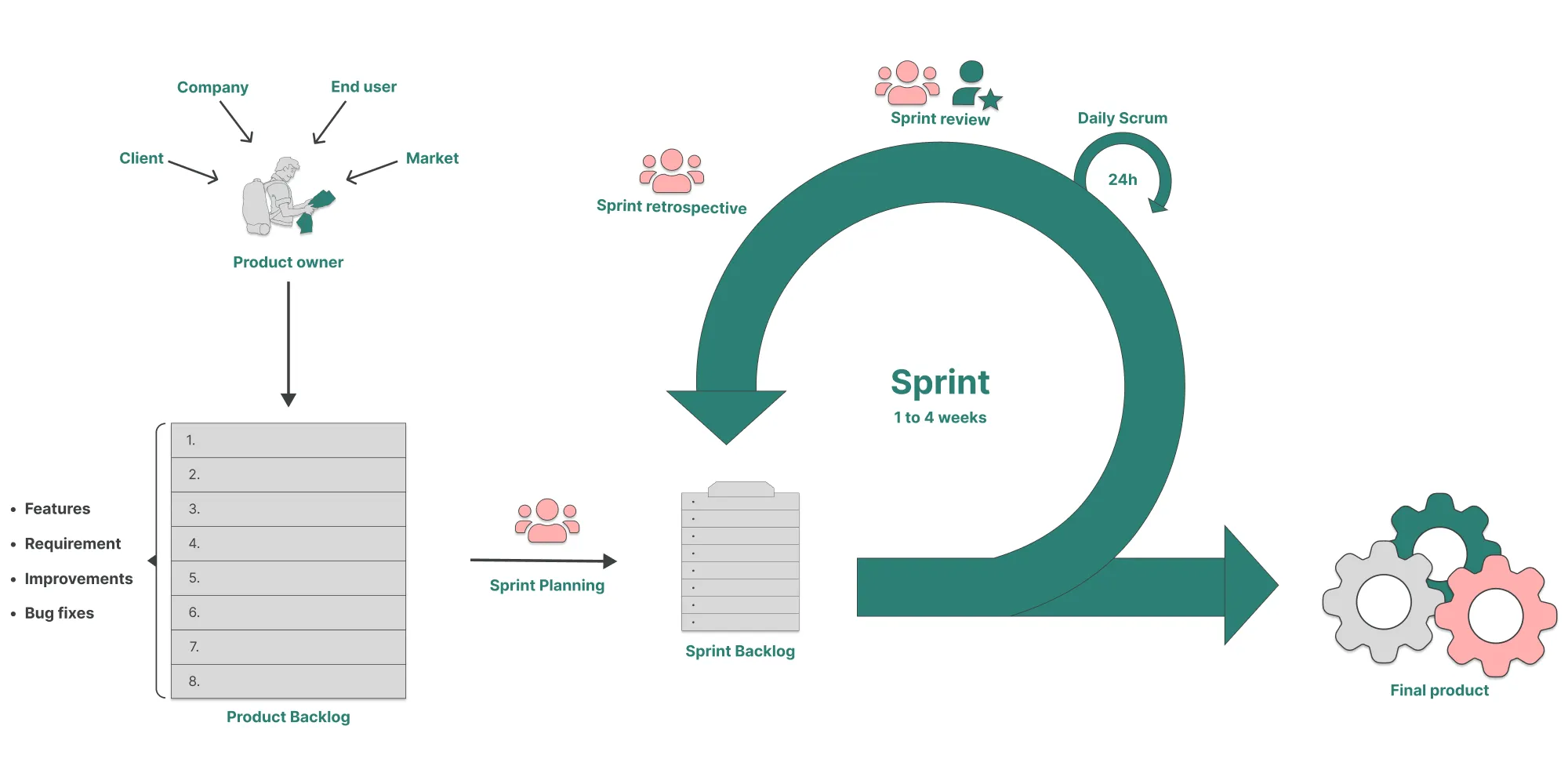
- The Product Owner: a true domain expert, responsible for designing and defining the product. They maintain ongoing contact with the customer to understand and translate needs into concrete requirements. Drawing on their expertise, they set and prioritize features based on customer expectations, company goals, and market trends. Their role is crucial to keep the project vision aligned with the value delivered to users.
- The Scrum Master: the team’s coach, ensuring all stakeholders move forward in sync throughout the project. Guardian of Scrum practices, they facilitate internal and external communication, streamline workflows, and support effective collective decision-making. They also ensure transparency and remove impediments that could slow the team down.
- The Development Team: typically 2 to 5 experts, responsible for all technical work required to deliver the product or service. Supported by the Scrum Master, the team is autonomous and focused on building and completing tasks. It also estimates the workload it can take on during each iteration, ensuring a realistic and sustainable pace.
The 3 key Scrum artifacts
- The Product Backlog: the master list of work, owned by the Product Owner. It is dynamic and evolving, combining features to build, product requirements, desired improvements, and fixes. Similar to a to-do list, it is reassessed every iteration based on customer feedback, product evolution, and uncertainties.
- The Increment (deliverable): the core objective of each iteration. It is the tangible result produced by the Development Team during a sprint. It makes progress visible and provides immediate, real value to the customer.
- The Sprint Backlog: a selection from the Product Backlog chosen by the Development Team to complete during the current iteration. It contains features to implement, technical needs, and fixes. While the sprint backlog may evolve during the sprint, the increment defined at the start of the sprint does not change.
Scrum events and ceremonies
The Agile team manages sprints using structured events that ensure maximum transparency and rhythm the sprint. In Scrum, an event is a time-boxed recurring meeting used to synchronize the team, share essentials, and adjust plans. Scrum defines five key events:
- The Sprint: a short development cycle, up to 4 weeks, aiming to deliver a new high-quality product increment to the customer. The first sprint starts at project kickoff, and each new sprint begins immediately after the previous one ends.
- Sprint Planning: a 2–8 hour event that launches the sprint. Its goal is to determine what can be delivered and how to achieve it. The Product Owner presents the sprint’s “What”: the goal and the prioritized backlog items needed to meet it. The Development Team then selects and plans the work based on value and effort.
- Daily Scrum: a daily 15-minute team meeting to check sprint progress: each member shares what was done, what will be done next, and any impediments.
- Sprint Review: held at the end of the sprint to present the increment to the customer and collect feedback. It verifies alignment with the product vision and adjusts the trajectory as needed.
- Sprint Retrospective: for the Scrum Team only, immediately after the Sprint Review. It identifies improvements for upcoming sprints.
Why Scrum isn’t for everyone? Preconditions and constraints
Scrum is a semi-prescriptive approach, meaning it can be tailored to any organization while respecting its core principles. It is easy to understand and explain, but hard to master. It requires:
- An autonomous, self-managing team capable of taking initiative.
- Solid project management maturity, with high-quality information flowing up to management.
- Trusting leadership ready to delegate and empower the team.
- A full-time dedicated team, with no critical dependencies on external contractors.
As with any Agile approach, the customer must be involved and available, enabling communication based on trust and transparency.
Discover other project management methods
Orchesia: the ideal software to support your Product Owners
Don’t confuse agility with anarchy! For Agile to work, certain conditions must be in place.
With Orchesia, ensure those conditions are met thanks to our real-time collaborative workspace. Each team member is autonomous and accountable, while customizable tasks and tickets ensure high-quality status reporting.
Our interactive dashboards provide a global view of the project, allowing management to track progress without micromanaging by delegating effectively to teams. With customizable roles, customers enjoy full transparency, fostering fluid, real-time communication.
Whether you work with objectives, deliverables, tasks or with epics, user stories, and features, Orchesia’s visual approach helps Product Owners structure, organize, and prioritize their product backlog—enabling precise sprint planning and tracking.
Try our project management software Orchesia free for two weeks, no commitment!